

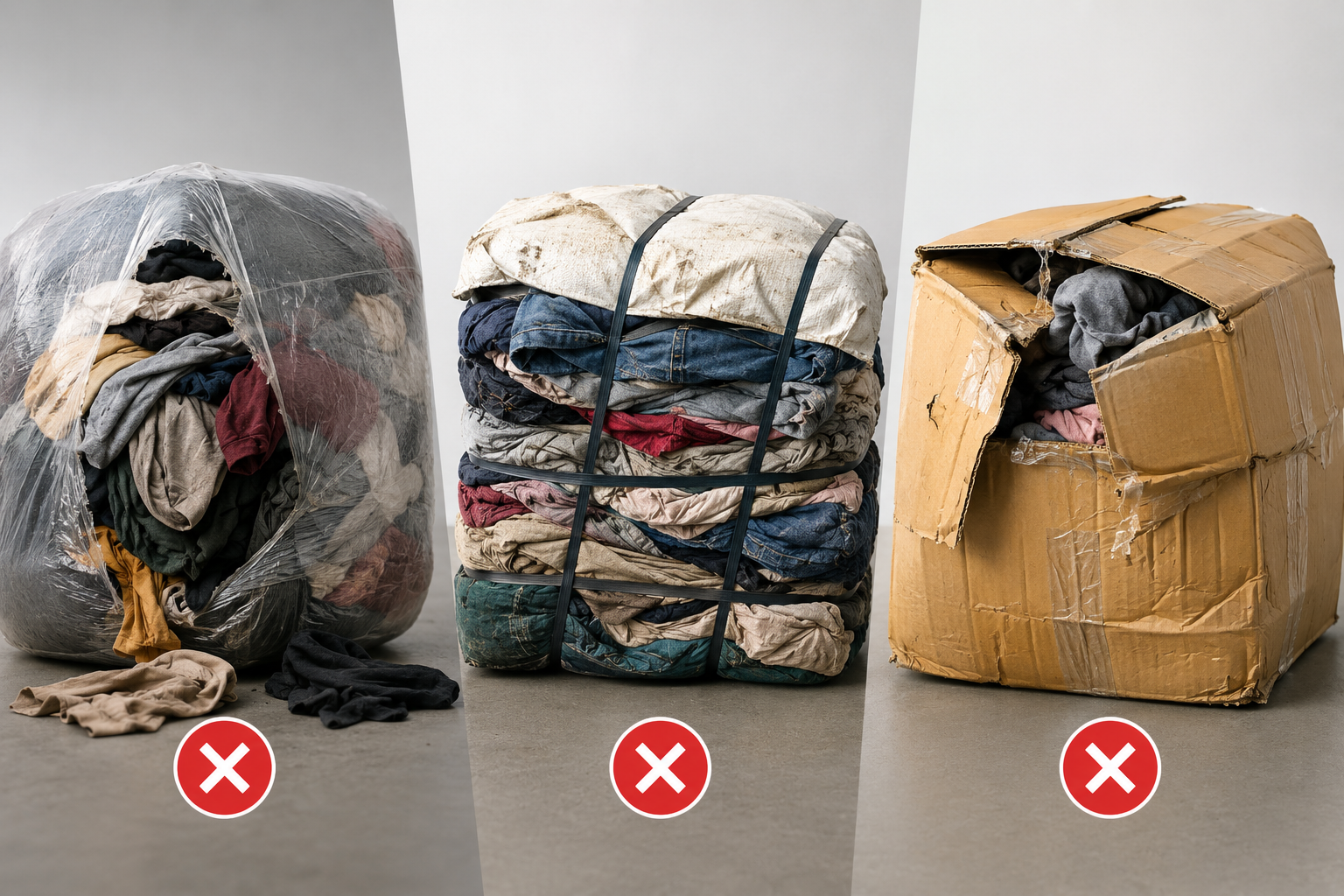
You did your homework. You sourced good stock at a fair price. But when the bale arrives and you open it — the profit you planned for has quietly disappeared. Here is what is really going on.
Most buyers blame the grade. But more often than not, the grade was fine — it was the packing that let everything down.
Packing is the last thing a supplier does before your stock leaves their warehouse. But it is the first thing that affects your business when it arrives. Get it wrong, and even a perfectly sorted bale becomes a problem you have to pay to fix. These are the three most common ways it goes wrong.
MISTAKE 01
What’s inside the bale doesn’t match what’s on the label
You order a bale of women’s tops. The label says women’s tops. But when you open it, you find children’s clothes, a few pairs of trousers, and some accessories mixed in. Now you have a problem — because your storage, your pricing, and your customers are all set up around what you ordered, not what you got.
This happens when suppliers rush the packing process or don’t have a proper sorting system in place. To them, it might seem like a small thing. To you, it means spending extra time re-sorting stock on arrival, selling mixed inventory at a lower price, or missing delivery commitments to your own customers.
The result? You pay a specialist price for a mixed bag.
REAL TALK
A good supplier labels each bale accurately and backs it up with a detailed packing list. If your supplier cannot tell you exactly what is in every bale before it ships — that is a red flag.
WHAT IT COSTS YOU
Extra sorting labour + lower resale price on mixed stock
WHAT TO ASK FOR
Bale label + packing list that match exactly, every time
MISTAKE 02
Good clothes on the outside, worse clothes hidden in the middle
Picture this: you receive a bale, you check the top layer, and everything looks great — clean, well-sorted, proper Grade A. So you sign off on the shipment. But as you dig deeper into the bale, the quality drops. Grade B items start appearing. Then Grade C. By the time you reach the bottom, you have a very different picture from what you inspected on arrival.
This is one of the oldest tricks in the used clothing trade. Suppliers pack the good stuff on the outside — the part you can see — and use lower-grade items to fill the inside. You pay Grade A price for the whole bale, but you only got Grade A for the part you could see.
It is hard to catch unless you fully unpack every bale, which most buyers don’t have time to do. The damage shows up later, when your customers start returning items or complaining about quality.
REAL TALK
A trustworthy supplier packs the same grade from top to bottom — every single time. The outside of the bale should look exactly like the inside. If a supplier gets defensive when you ask to inspect a random middle section, now you know why.
WHAT IT COSTS YOU
Pay Grade A rate, receive 60–70% Grade A value in reality
WHAT TO ASK FOR
Consistent grade all the way through — not just the top layer
MISTAKE 03
Good clothes on the outside, worse clothes hidden in the middle
Your bale travels across the ocean for three to five weeks inside a shipping container. During that journey, containers get stacked, shifted, tilted, and knocked around. A bale held together with thin plastic wrap and weak strapping bands — the kind some suppliers use to cut costs — will not survive the journey in one piece.
When strapping snaps or wrapping tears, the bale opens inside the container. Clothes fall loose, mix with other bales, and arrive in a jumbled mess. All that careful sorting and grading? Gone before it even reaches you. You are left spending hours untangling stock that should have arrived neat and ready to sell.
Good packing uses proper industrial-grade materials: thick woven wrap, strong polyester or steel strapping, and at least four strap points per bale. It costs suppliers a little more — but it is the only way your stock arrives the way it left.
REAL TALK
Ask your supplier to send you a photo of a packed bale before it ships. A supplier who takes packing seriously will have no problem showing you. One who hesitates is probably cutting corners somewhere.
WHAT IT COSTS YOU
Hours re-sorting loose stock; grades and categories mixed up
WHAT TO ASK FOR
Industrial wrap + 4-point strapping + bale photo before shipment
Three quick questions to ask your supplier before you order
You don’t need to be an expert in logistics to protect your margin. You just need to ask the right questions:
✓ “Can you send me a photo of the packed bale before it ships?” — A reliable supplier will say yes without hesitation.
✓ “Is the grade consistent throughout the whole bale, not just the top?” — The right answer is yes. Any vague response is a warning sign.
✓ “Does your packing list match exactly what is in each bale?” — There should be no guesswork. What is on label/code/description should be what is inside.
These are not complicated questions. But how a supplier answers them tells you a lot about how seriously they take your business.
We show you before it ships — every time.
At P&P Textiles, we send bale photos, accurate packing lists, and grade breakdowns before every shipment. No surprises when the container arrives. Get in touch at pptextiles.com and let’s talk about what you need.