

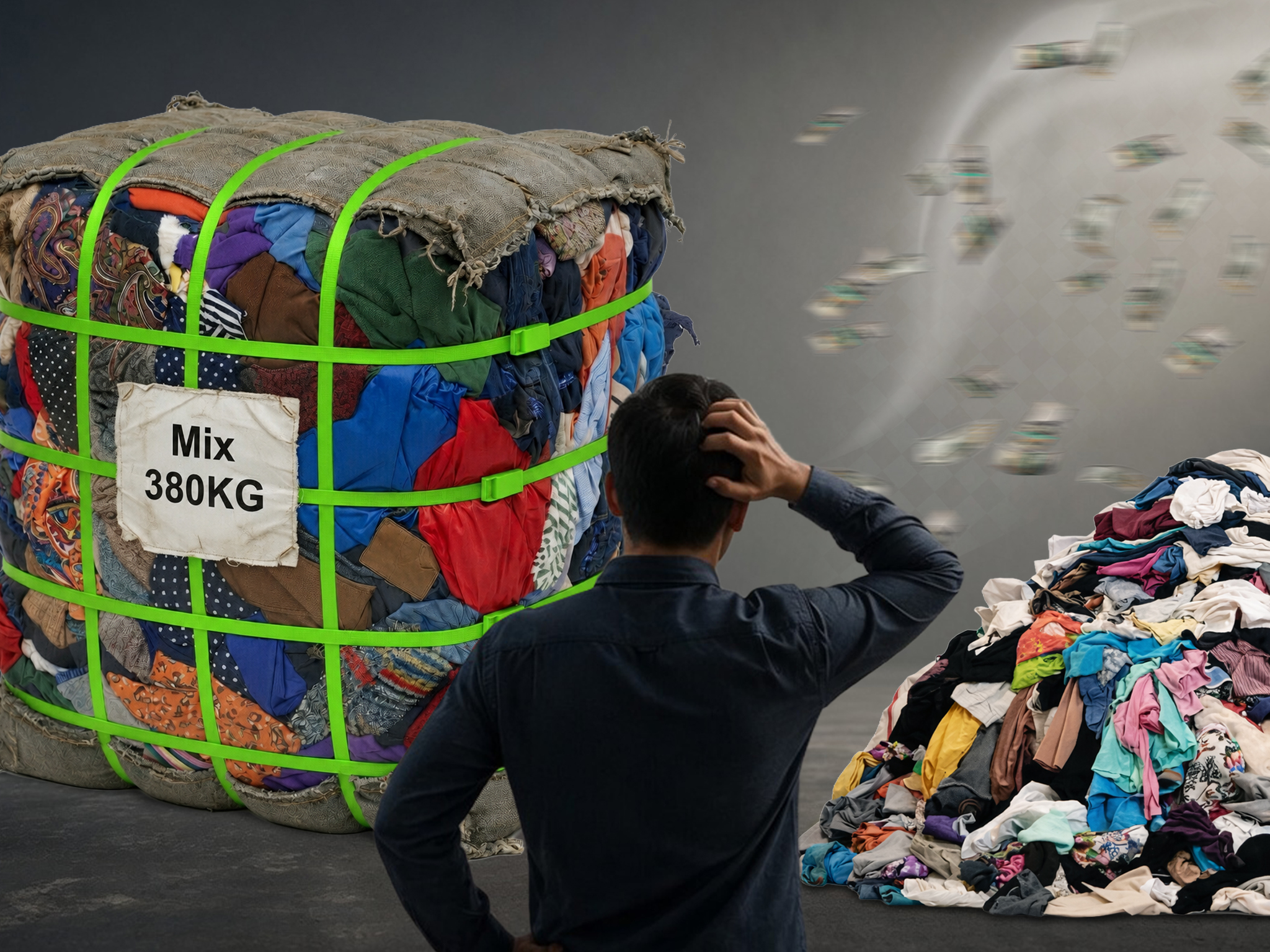
It looks like a bulk deal. A single 380 kg mixed clothing bale at a price that seems hard to argue with. One purchase, one delivery, done.
But the moment that bale arrives at your warehouse — and you cut the strapping and pull back the wrapping — the real cost begins. Because mixed cloth is not a product. It is a problem you have just paid someone else to hand to you.
Your Time Is Your Inventory
In the resale business, time is not just money — it is your primary competitive asset. Every hour you or your staff spend sorting through an unsorted mixed bale is an hour not spent selling, building customer relationships, or managing your next purchase.
Consider what receiving a 380 kg mixed bale actually requires:
| Task | Estimated Time (380 kg mix) |
| Unpack and spread contents | 1.5 – 2 hours |
| Sort by category (tops, pants, etc.) | 3 – 5 hours |
| Sort by gender / age group | 2 – 3 hours |
| Sort by condition / grade | 2 – 4 hours |
| Re-bundle for sale or storage | 1 – 2 hours |
| Total sorting effort | 9 – 16 hours |
That is a full working day — or more — before a single item is ready to sell. If you run a lean operation, that is time pulled from your core business. If you pay staff to sort, that is a direct labour cost that never appears on the supplier’s invoice.
What “Mix Cloth” Actually Means
When a supplier offers “mixed clothing,” they are not offering a curated product. They are offering the output of a bulk collection process — whatever came in, compressed together, sold as-is. The contents could be:
- Children’s clothing mixed with menswear and ladies’ pieces
- Winter coats alongside summer T-shirts
- Premium condition items mixed with heavily worn stock
- Multiple fabric types, sizes, and styles with no organising logic
There is no specification because there is no specification process. You are buying uncertainty, and paying wholesale prices for it.
The Specialised Bale Advantage
A specialised bale from a graded supplier like P&P Textiles works differently. Instead of receiving a chaotic mix, you receive a bale built around a defined category — ladies’ blouses, men’s casual tops, children’s outerwear, denim, knitwear, and so on.
What this means for your business in practice:
| 380 kg Mixed Bale | 100 kg Specialised Bale (P&P) | |
| Content clarity | Unknown until sorted | Defined before purchase |
| Sorting time on arrival | 9 – 16 hours | Minimal — ready faster |
| Usable for niche sales | After sorting only | Immediately |
| Livestream readiness | Not practical unsorted | Direct — same category |
| Car boot / market prep | Hours of pre-sorting needed | Unpack and display |
| Customer targeting | Broad — less precise | Precise niche audience |
| Stock planning | Unpredictable | Consistent, repeatable |
Why This Matters for Modern Resellers
Livestream Sellers
Livestream reselling on TikTok, Shopee Live, or Facebook Live is one of the fastest-growing channels for bundle clothing in Malaysia. Your audience tunes in to see a specific type of product — not a random assortment. A specialised 100 kg ladies’ blouse bale lets you open, display, and sell confidently within minutes of going live. A mixed bale requires you to pre-sort offline before the camera goes on — assuming you have the time.
Car Boot and Market Sellers
At a car boot sale or pasar malam, you have a fixed stall space and a limited setup window — typically 30 to 60 minutes before customers arrive. Arriving with specialised bales means you can set up by category: one rail for men, one for women, one for children. Arriving with a mixed bale means you are still sorting when your first customer walks past.
Your display quality also improves. Neatly arranged, category-specific stock draws a customer in and makes the browsing experience easier. A jumbled mix sends them to the next stall.
Niche and Repeat Customers
The most valuable customers in the resale business are repeat buyers — people who come back because they know you carry what they want. A buyer who knows your stall always has quality ladies’ workwear, or always has good children’s clothing, will return reliably. That loyalty is impossible to build if your stock is inconsistent every week because your supplier sends you unsorted mix.
The Real Cost Comparison
When you account for all costs — not just the purchase price — the economics shift significantly:
| Cost element | 380 kg Mix Bale | 100 kg Specialised (P&P) |
| Purchase price | Lower headline cost | Transparent per-kg pricing |
| Sorting labour (est.) | RM 150 – 300+ | Minimal |
| Time cost (opportunity) | High — 1 full day+ | Low — sell faster |
| Unsellable / wrong category | Higher risk | Lower — you chose the category |
| Repackaging for resale | Required | Often direct-to-sell |
| Total effective cost | Higher than quoted | Transparent, predictable |
A 380 kg mixed bale that costs RM X rarely costs only RM X once you account for what you do with it after it arrives.
The Right Way to Scale Your Resale Business
Experienced distributors and resellers consistently arrive at the same conclusion: specialised bales are not a premium product — they are a more efficient product. The question is not whether you can afford to buy specialised stock. The question is whether you can afford not to.
As your volume grows — more stalls, more livestreams, more downstream customers — the sorting burden of mixed bales does not stay constant. It multiplies. Every additional 380 kg mixed bale you purchase adds another sorting cycle. Specialised bales scale cleanly: more bales, more categories, more sales — without the bottleneck.
Buy for what you want to sell. Not for what you are willing to sort.
At P&P Textiles, every bale is packed by category. You know what you are getting before it arrives — ladies’ tops, men’s casual, children’s outerwear, denim, and more — at a consistent 100 kg standard, graded and ready for your market.
Ready to Talk?
Reach out to our team to discuss your requirements, available stock, and how we can support your distribution network.
Email: pp.textiles@gmail.com
Phone / WhatsApp: +6016 881 2185 / +6016 336 2185
Website: https://pptextiles.com