

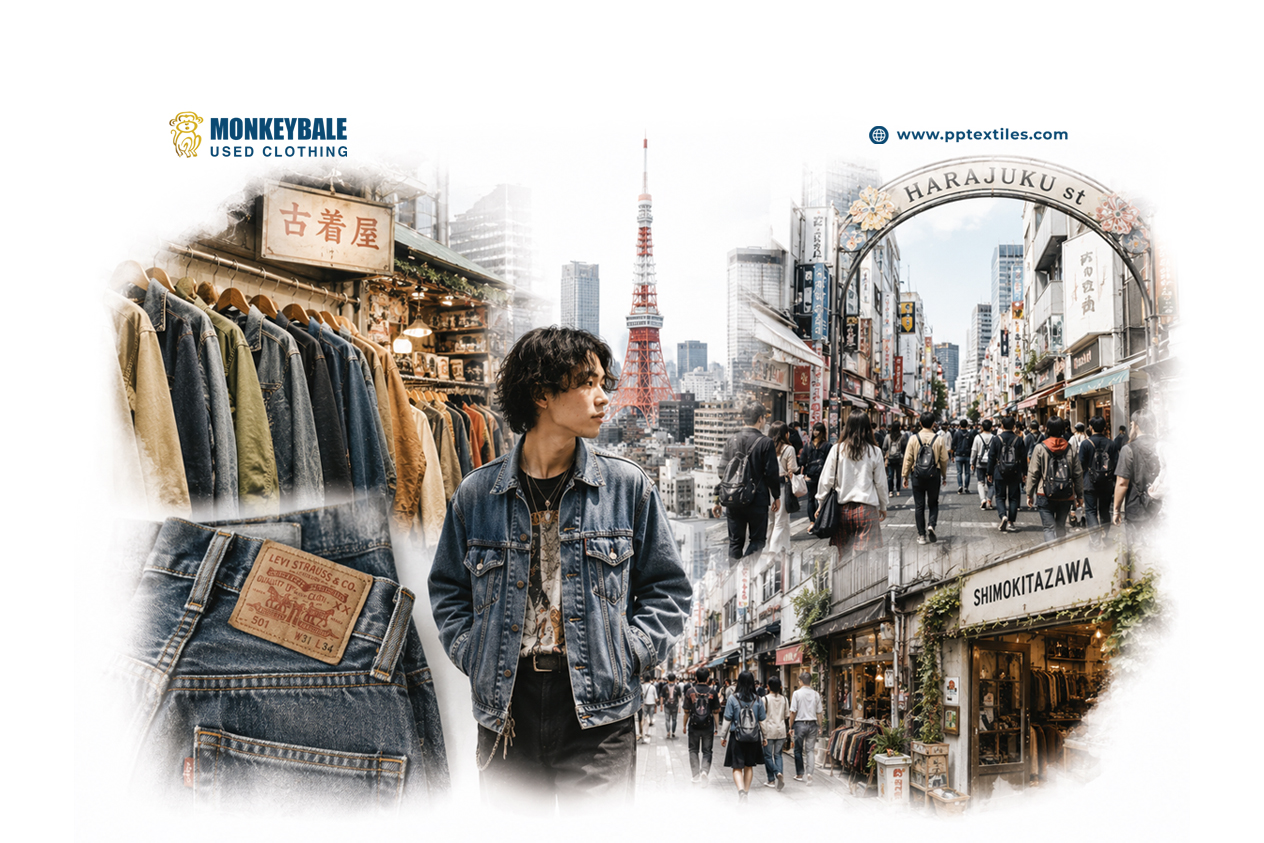
When people think about second-hand fashion, they tend to picture charity shops on British high streets or sprawling thrift stores in small-town America. The imagination doesn’t naturally travel to Japan. Yet some of the most influential vintage culture in the world — the ideas, the standards, the obsessions that now shape how collectors everywhere think about old clothing — emerged not in the West, but in Tokyo.
To understand how that happened, you have to go back to the rubble.
The origins of furugiya (ふるぎや / 古着屋 )
In the years after World War II, Japan was a country rebuilding from almost nothing. American occupation forces arrived with supplies, infrastructure — and clothing. Military surplus, workwear, denim: garments that had been manufactured in vast quantities for the war effort suddenly found their way into Japanese markets. For many Japanese people, this was their first encounter with American fabric and construction.
The stores that sold these goods became known as furugiya (ふるぎや / 古着屋 ) — second-hand shops. They were not glamorous. They were practical. But they planted something. A generation of Japanese consumers grew up handling American-made clothing at a time when Japanese manufacturing was still finding its footing, and they noticed the difference. The rivets in Levi’s jeans. The weight of military-grade canvas. The way a good pair of work boots aged.
What began as necessity became education.
Japan didn’t love old clothes because they were cheap.
It loved them because they were good.
This is the distinction that sets Japanese vintage culture apart from almost anywhere else in the world. The appreciation was never primarily about price. It was about quality — specifically, the perception that American manufacturing of the mid-twentieth century had reached a peak that later decades failed to sustain.
Japanese collectors didn’t just buy old denim. They catalogued it, studied it, and replicated it — more faithfully than the Americans who had originally made it.
Levi’s 501s from specific decades were sought not as fashion statements but as artefacts. Vintage military field jackets were prized for the density of their cotton and the precision of their stitching. Workwear — denim overalls, railroad shirts, chore coats — was collected and preserved with the kind of care normally reserved for antiques. Japanese collectors didn’t just buy old denim. They catalogued it, studied it, and replicated it — more faithfully than the Americans who had originally made it.
This gave rise to an entire domestic industry: Japanese selvedge denim weavers producing fabric closer to mid-century American standards than anything then being made in the United States. Companies like Oni, Studio D’Artisan, and Evisu emerged from this obsession. The student had, in some ways, surpassed the source.
KEY IDEA
Japan didn’t love old clothes because they were cheap. It loved them because they were good — and it built an entire industry to honour that belief.
Harajuku (原宿) and Shimokitazawa (下北沢)
By the 1980s and 1990s, vintage had moved off market stalls and into culture. Two Tokyo neighbourhoods became its twin capitals.
Harajuku
原宿
Where youth fashion exploded into global view. The street style that emerged here — layered, eclectic, historically promiscuous — made vintage clothing not just acceptable but aspirational. Photographers and stylists from across the world arrived to document it.
Shimokitazawa
下北沢
The quieter, more neighbourhood-scale counterpart. Where the serious collectors shopped. Its winding streets and independently owned stores became a pilgrimage destination for anyone who cared about second-hand clothing at a deeper level.
Together, these districts demonstrated something important: vintage clothing could sustain entire ecosystems of commerce and creativity. The model was studied, and eventually imitated, around the world.
Mercari changed everything
The final piece of Japan’s contribution to global vintage culture came not from a shop or a subculture, but from a smartphone app. When Mercari launched in 2013, it did something that seemed simple but was, in practice, transformative: it made it easy for anyone in Japan to sell anything to anyone else.
The second-hand market, which had always been geographically bounded — you had to be in Shimokitazawa to shop in Shimokitazawa — suddenly became national, then international. Sellers who once relied on foot traffic could reach buyers across the country. Rare finds that might have sat in a shop for months sold within hours. The liquidity of the second-hand market increased dramatically.
The model spread. Depop launched in the UK. Vinted across Europe. Poshmark in the US. Each platform owed something — whether directly or in spirit — to the idea that second-hand goods deserved a serious, scalable marketplace. Japan had provided the cultural proof of concept. Technology provided the infrastructure.
The foundations were already in place
By the time social media arrived — by the time thrift hauls became a genre on YouTube and vintage finds filled Instagram feeds — the foundations were already in place. Vintage culture had become global not because of an algorithm, but because decades of Japanese craftsmanship, collecting, and commerce had demonstrated that old clothing was worth taking seriously.
Technology simply accelerated what culture had already made inevitable.
But behind every vintage find and thrift haul, behind every Mercari listing and charity shop rail, was a less visible story. A logistics story. A supply chain moving millions of garments around the world every single day — sorted, baled, shipped, and resold across continents most buyers never think about.
That story is next.