

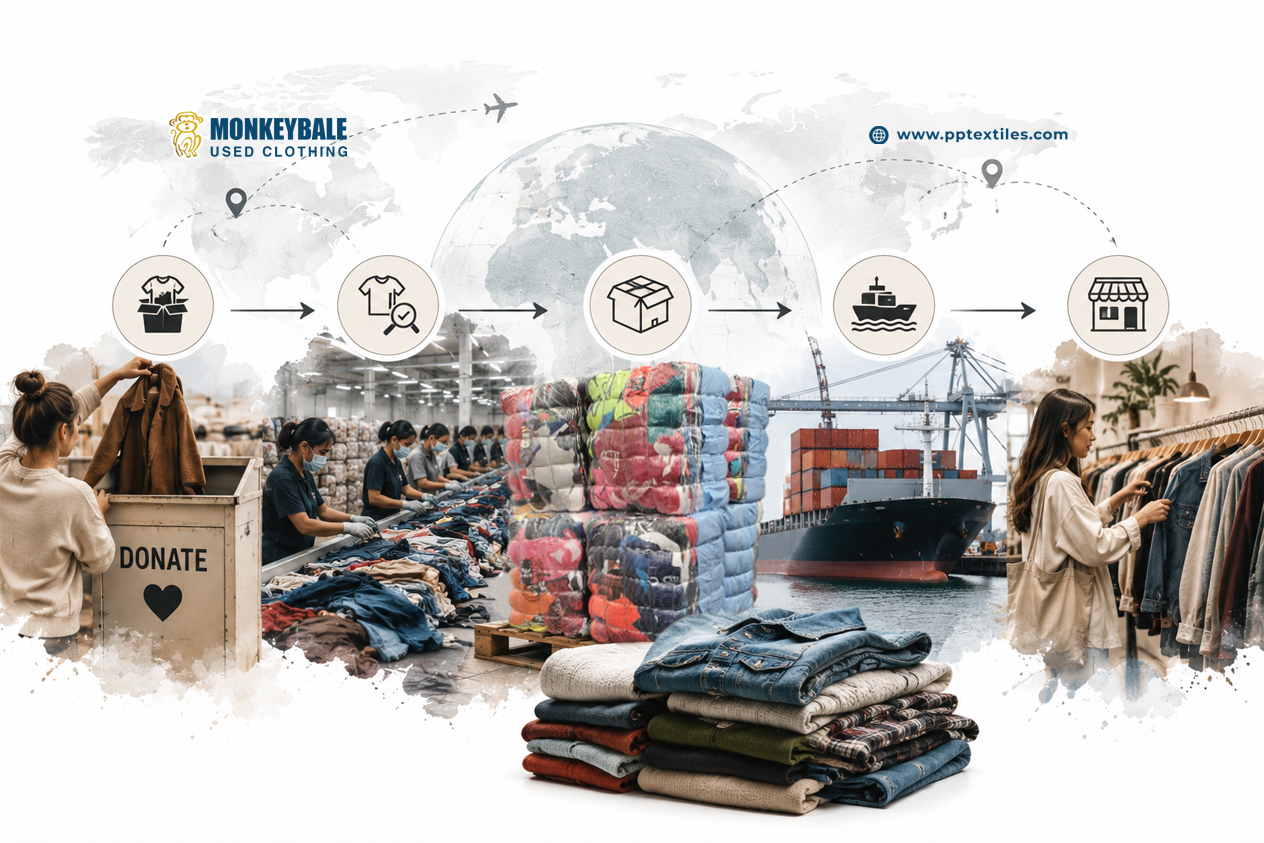
Every thrift shopper sees the final step. A jacket on a rack. A shirt on a hanger. A vintage find that feels serendipitous, as though it had been waiting there just for them. Very few ever consider the journey that happened beforehand — the sorting, the grading, the shipping, the chain of hands the garment passed through before it arrived on that rail.
That journey is longer, more complex, and more global than most people imagine.
01
Donation
02
Collection
03
Sorting & Grading
04
Global Export
05
Regional Distribution
06
Retail
The donation stage
It begins at home. A wardrobe clear-out. A bag left outside a charity shop. A donation to a textile bank at the supermarket car park. Every year, hundreds of millions of garments enter this first stage — discarded not because they are worn out, but because they are unwanted.
The collection systems that receive these garments vary widely. Charity shops operate their own donation infrastructure. Textile recycling companies install collection bins in public spaces. Local authorities run household collection schemes. Corporate take-back programmes — run by major retailers — have become increasingly common, particularly as sustainability commitments have moved from aspiration to expectation.
What all these systems share is that they aggregate garments from thousands of individual donors into large-scale volumes that can be sorted and distributed. The donation is the start of a supply chain, even if the person handing over a bag of old clothes never thinks of it that way.
Sorting and grading: where expertise matters
If the donation stage is about volume, the sorting stage is about precision. This is where the second-hand economy becomes a skilled industry.
Not every donated garment is destined for a charity shop rail. The sorting process determines what gets sold where — and at what price.
Garments arriving at sorting facilities are assessed across several dimensions. Category sorting separates clothing by type — tops, bottoms, outerwear, footwear, accessories — since different categories flow to different markets and carry different values. Within each category, quality grading assesses the condition of individual pieces: a barely worn coat is worth considerably more than one that is faded, pilled, or damaged.
Wearability assessment goes further, asking whether a garment is suitable for direct retail sale, whether it requires minor repair or cleaning, or whether its condition means it should be redirected to material recycling rather than resale. Market suitability adds another layer of complexity: a garment that has limited appeal in a Western European charity shop might be highly sought after in a different regional market, where consumer preferences, climate, and price sensitivity differ.
This expertise — the ability to read a garment quickly, grade it accurately, and route it correctly — is what separates a well-run sorting operation from a chaotic pile. It is not glamorous work, but it is the work that makes the entire second-hand economy function.
Global distribution
Once sorted and graded, second-hand garments enter one of the world’s most underappreciated logistics systems. Baled by category and grade, they are loaded into shipping containers and dispatched across continents.
The geography of this trade is not random. It follows patterns shaped by economics, trade relationships, and consumer demand. Western Europe and North America are the primary source regions — places where high per-capita consumption creates large volumes of donated clothing. East Africa, South and Southeast Asia, Latin America, and parts of Eastern Europe are major destination regions, where second-hand imports fill gaps in local clothing markets or feed the appetite of collectors and traders.
Within those destinations, garments move through layers of distribution. Importers buy containers and break them down into smaller lots. Regional wholesalers purchase by category. Individual retailers and market traders buy by the bale. At each stage, the garments are sorted again, priced again, and moved closer to the consumer who will eventually buy them.
The final step — a jacket on a rack, a shirt on a hanger — is the smallest part of the journey.
Where P&P Textiles fits
Businesses like P&P Textiles operate within this global ecosystem, helping ensure that second-hand garments are properly sorted, graded, packed, and distributed to retailers and wholesalers across different markets. The role is, at its core, one of reliability: consistent quality grading, dependable volume, and the logistical competence to move goods across borders efficiently.
KEY IDEA
While consumers may only see the final product on a shop rail, a reliable supply chain is essential to making the second-hand economy work at scale.
For retailers and wholesalers sourcing second-hand stock, the quality of their supply chain partner determines everything downstream — the proportion of garments that are sellable, the consistency of what they receive bale to bale, and ultimately the experience of the customer browsing their shop or website.
As the second-hand market has grown, so has the expectation of professionalism at every stage of the supply chain. Buyers want transparency, consistency, and accountability. The days of the second-hand trade operating as an informal, unstructured system are giving way to something that looks increasingly like any other organised retail supply chain — with the added dimension of sustainability at its core.
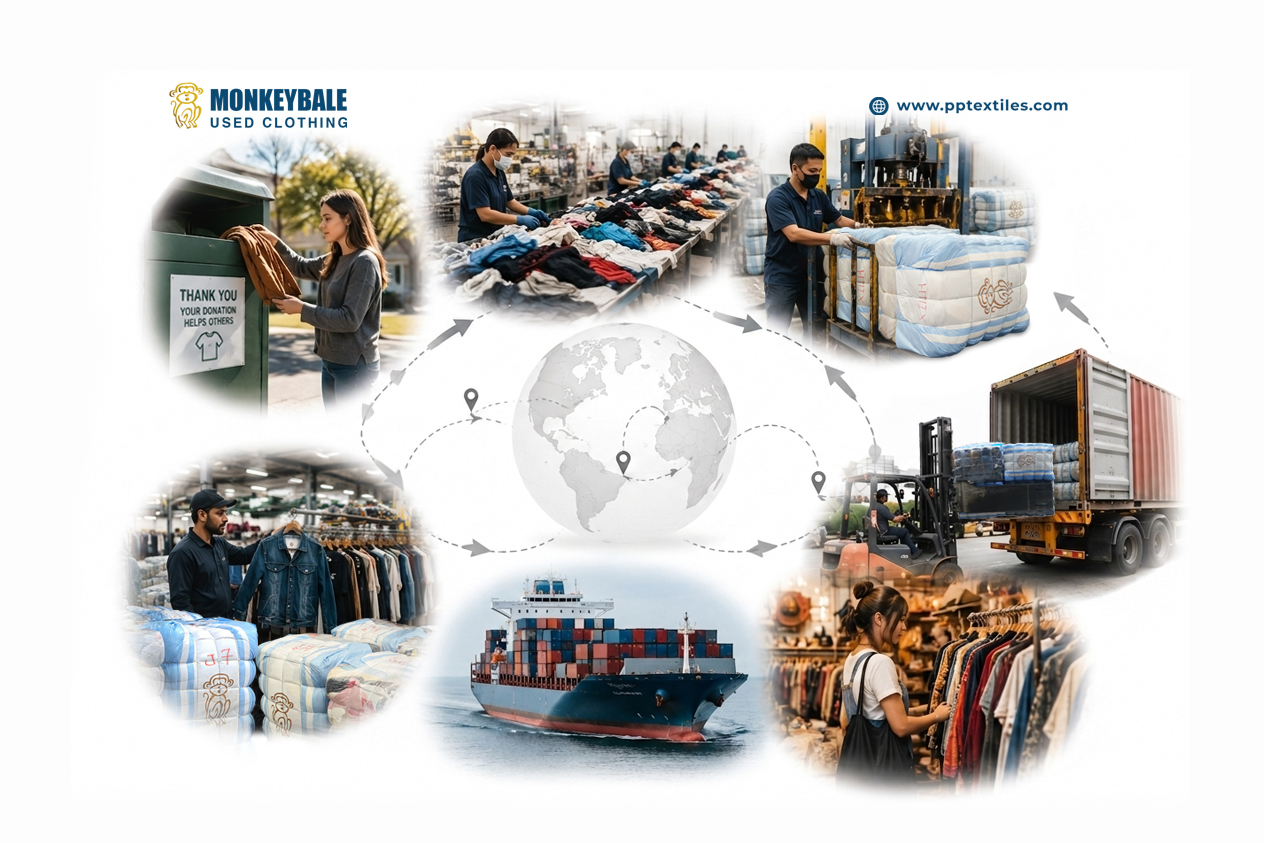
The infrastructure behind the accident
The rise of second-hand fashion may have been accidental. Nobody planned it. It emerged from necessity, was shaped by culture, and was accelerated by technology. But the infrastructure supporting it is not accidental at all.
Every garment that finds a second life depends on thousands of people working across a global network — donors, collectors, sorters, graders, exporters, importers, wholesalers, and retailers — transforming unwanted clothing into valuable inventory. It is a chain that spans continents and involves expertise that is rarely visible to the consumer browsing a rail.
As circular fashion continues to grow, that network will not just be useful. It will be essential. The brands and businesses that understand and invest in the supply chain behind second-hand will be the ones best placed to meet the demand that is already here — and the far greater demand that is coming.