

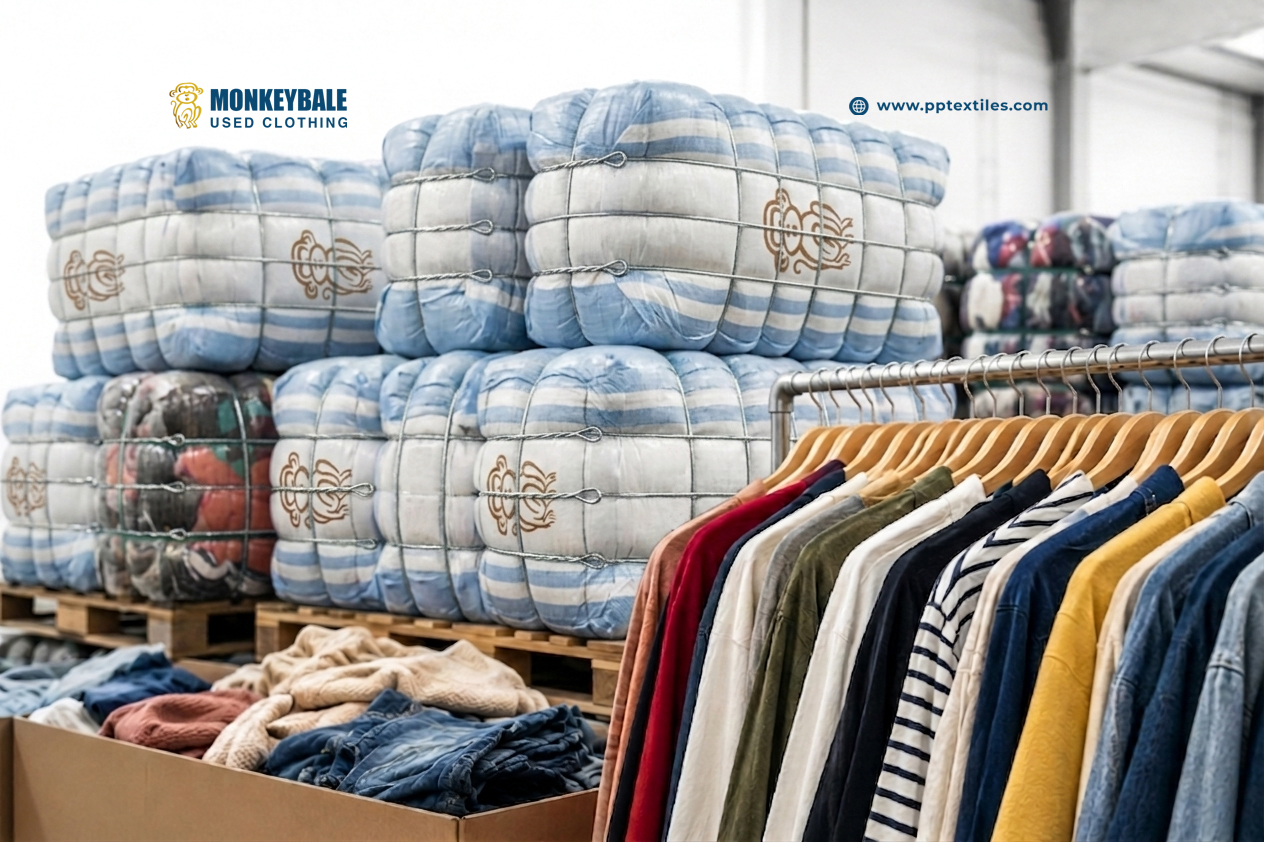
Most wholesalers treat July as a quiet month — a gap between Q2 clearance and the back-to-school rush. The smartest ones treat it as the most strategic window of the year to diversify their stock.
In the used clothing wholesale trade, timing is everything. The buyers who consistently outperform their markets aren’t simply those with the best product — they are the ones who understand when to move, when to hold, and when to introduce something new. July sits at a unique inflection point in the annual trading calendar, and for distributors and retailers sourcing Japanese second-hand apparel, it presents a rare opportunity to reposition inventory before the second-half demand surge begins.
At P&P Textiles, we’ve spent over 25 years observing market rhythms across Asia, Africa, and the Middle East. What we consistently see is this: the wholesalers who use July wisely — to refresh, diversify, and test new product categories — arrive at Q3 and Q4 with a clear competitive edge.
8,800
Tonnes of Used Textiles Processed Annually
25+
Years of experience in used apparel
6+
Product categories available for new buyers
Why the Mid-Year Moment Matters
The global used clothing market does not run on a single calendar. Different markets peak at different times — Eid shopping cycles in the Middle East, the rainy season demand shift in Southeast Asia, the back-to-school period across Africa. July, sitting squarely in the middle of these overlapping rhythms, is paradoxically one of the calmest months for order volume — which makes it the ideal time to think and act strategically rather than reactively.
When order pressure is lower, buyers have more room to negotiate bale composition, request category trials, and plan for volume scaling without the urgency that drives poor decisions. This is the window. Miss it, and you spend Q3 scrambling. Use it, and you spend Q3 selling.
At P&P Textiles, July is often when buyers request trial orders, explore new bale categories, and prepare inventory strategies for the second half of the year.
The wholesalers who thrive in Q4 are not the ones who ordered the most in October — they are the ones who planned in July.
— P&P Textiles, 25 years of partnership experience
What “Introducing a New Category” Actually Means
Many buyers assume category diversification means ordering a completely different product line — a risky, capital-intensive commitment. In practice, smart category introduction looks much more incremental. It means adding one new bale type alongside your regular order to test market reception, without disrupting your core supply.
At P&P Textiles, we supply a broad range of professionally sorted categories sourced from Japan, each with distinct market profiles and resale dynamics. Here is how each category plays a role in a diversified stock strategy:
P&P TEXTILES - CORE PRODUCT CATEGORIES
- Men’s Used Clothing: Consistent volume seller; shirts, trousers, jackets. Ideal anchor category for any new buyer.
- Women’s Used Clothing: Fastest-moving in urban retail markets; drives repeat purchasing. Strong resale margin on Japanese branded items.
- Children’s Used Clothing: Lower price sensitivity from buyers, strong end-consumer demand particularly in emerging markets — a high-velocity category often overlooked.
📍Popular among buyers in East Africa, Southeast Asia and South Asia. - Household & Home Textiles: Bedsheets, towels, curtains — a growing category as circular home goods gain traction. Excellent complement to apparel bales.
📍Growing demand among retailers serving budget-conscious households. - Accessories: Bags, belts, hats, and scarves. High-margin add-ons that increase per-bale revenue for retail distributors.
- Wipers & Rags: Industrial off-take with stable institutional buyers. A reliable volume outlet for lower-grade stock.
The Case for Children’s Clothing and Home Textiles in July
If there are two categories that consistently underperform in terms of buyer adoption relative to their actual market demand, they are children’s clothing and home textiles. Both are frequently passed over by buyers focused on the volume certainty of men’s and women’s apparel — but this is precisely why they represent opportunity.
Japanese-sourced children’s clothing is, by the standards of the global used clothing market, exceptional. Japanese parents tend to dress children in well-made, lightly worn garments with strong brand penetration — meaning the quality profile of a children’s bale from Japan will typically outperform equivalent product from other source countries. Markets in sub-Saharan Africa, Southeast Asia, and South Asia respond strongly to this quality differential, and buyers who carry children’s stock alongside core adult apparel report meaningfully higher basket sizes from their own customers.
Home textiles, meanwhile, are benefiting from a broader shift in how end consumers think about sustainability. Pre-loved homewares are increasingly a deliberate choice rather than a last resort, and buyers who build a home textiles offering now are positioning themselves ahead of what is becoming a mainstream purchasing behaviour across emerging markets.
Four Practical Steps to a Successful Category Introduction
01
Start with a Single Trial Bale
Request one bale of a new category alongside your regular order. Assess resale speed and customer response before committing to volume.
02
Clarify Grade Before You Order
Different grades serve different markets. Grade A suits premium retail; Grade B suits general trade. Know your end buyer before choosing.
03
Plan Logistics in Advance
New categories may require different storage or display setups. Planning in July means you’re ready to sell in August, not still organising in September.
04
Talk to Your Supplier
A good supplier knows what’s moving in your market before the data does. Use July to have those conversations — P&P Textiles’ team is always available to advise.
Why Japanese Sourcing Gives You a Starting Advantage
The country of origin matters enormously in second-hand clothing. Japanese garments carry a market reputation built on decades of quality signalling — careful ownership, meticulous storage, and strong brand variety across all categories. When you introduce a new category sourced from Japan, you are not starting from scratch on quality trust; the origin does much of that work for you.
This is especially significant when introducing children’s clothing or home textiles to a market that may not yet have an established preference for second-hand in those categories. The quality of the product itself becomes the argument. In our experience, buyers who run a small trial of Japanese-sourced children’s bales rarely need much persuasion to reorder — the sell-through rate makes the case.
Looking Ahead: July Orders, Q3 and Q4 Outcomes
The practical arithmetic of wholesale sourcing means that orders placed in July will shape your Q3 inventory and, depending on your market’s replenishment cycle, your early Q4 position. Given that Q4 carries the highest consumer spending indices across most of P&P Textiles’ served markets — including Eid al-Adha clearance cycles, Christmas gifting periods, and year-end market days — arriving at October with a diversified, tested inventory is a material commercial advantage.
Based on our experience working with wholesale buyers across multiple markets, those who test new categories earlier often enter peak selling seasons with greater confidence and inventory flexibility. The connection is direct: more testing in July means more confidence in October, which means better buying decisions, faster sell-through, and stronger margins.
If you are currently sourcing from P&P Textiles, now is the right time to speak to us about expanding your category mix. If you are a new buyer evaluating your options, July is genuinely one of the best months to begin — production capacity is available, our sorting team is at full capacity, and we have the lead time to build a bale composition that fits your market needs precisely.